Monday, April 15, 2013

Facebook vs. Google. Direct Internet Marketing (Advertising)

Which is better for Advertising?  Facebook or Google?  Hell if I know!  What is better anyways?  Different... would be a better way to explain Facebook vs. Google, so here goes how I see them as different from a Direct Internet Marketing perspective.

Here is the main difference: The Targeting is Different.

  • Facebook lets you target Age/Gender/Location/Likes, and more,  because it knows "who it's users are".
  • Google lets you target Location and "Search Term Keywords" only.
From a direct marketer's perspective Facebook might seem better. Marketers usually think of segmentation in terms of "demographics" and "psycho-graphics', and with Facebook's tools, you can really target a "market segment".

The problem with Facebook Targeting is that you have no idea of "buying intent".  You don't know if they are interested or care about your offer.

For Google, you target the key words that a person is searching for AT THAT MOMENT.  There is some kind of intent implied in the act of searching.  While this doesn't jive with Marketers view of segmentation, it certainly does have an impact on relevance to the user.

The difference in the CTR and CVR between the two platforms shows what I mean.
  • "Averages" from some of my own Facebook campaigns:   CTR: 0.025%   CVR: 0.012%  (yes a tenth of a percent)
  • "Averages" from some of my own Google Adwords campaigns:   CTR: 0.6%  CVR: 0.06%  (yes 6 tenths of a percent).
Meaning Google is between 20x better at click-through-rate, and at least 6x better at CVR.

Another big difference is the "Ad Frequency" settings of the two tools.
  • On Facebook, the ads are shown in smallish quantities until one of the ads in an ad group takes off... then the others get virtually no traffic.
  • On Google, you can SET the system to show ads evenly (when you are A/B testing, this is really really important).
So doing A/B testing on Facebook is almost impossible... (I havn't figured out a way to do it in a statistically meaningful way).

Instead, on Facebook, I do "Survival Testing"... ads that Survive (get impressions and seem to keep working at a decent rate) go into my "good group"  and ads that do not get enough testing, stay in the testing group until I have enough data to "kill them".   It's a very slow and tedious process.

I'm sure there is more differences as well... what differences do you think are key?
Wednesday, April 3, 2013

Our Brain on Infinity

This is a little thought experiment I adapted from a book (see below).

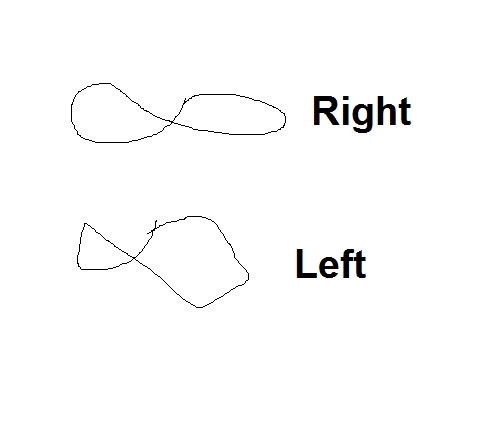
Write an infinity symbol with your writing hand (something you've probably done before).  Now switch and write it with your left hand (something you've probably NOT done before).  See, it can be done with your left hand without any practice, or without too much stumbling (although not perfect, see my attempt below).  How is that?   What did we learn about the brain that said, hey, something we've done with our right hand before, we can do with our left, on the first try!


To me, this example proves that the human mind "has representations" for things in it.  It proves that those representations can be passed and used by different brain systems.  And it proves that it is not a rote mechanical memorization; but rather an impression of vectors of what something should be.  It also kind-of shows how the human brain has "daemons" running that handle different tasks.  That the left hand could do what the right hand can do, means that the symbols for doing that were connected to neither.  That neither hand had the "motor memory" permanent in storage... and that the symbol itself was stored.  That the left hand could do it without practice shows that there must be a left-hand system in your brain that knows how to draw curves... and that that system was activated in order to draw the infinity symbol stored in your brain.

How is this useful to Marketing or Management... I'm not sure just yet.  But that is the beauty of learning new things... you just don't know how or when or even if it will be useful.  I suspect that this little tid-bit will be useful to me in the future though... if it ever is, if I use it to help me manage people or do some marketing magic, I'll let you know!

I adapted this idea form a book I'm reading the book called "How the Mind Works" by Steven Pinker.   This and so much more can be found in it!  I highly encourage you to read it.


Wednesday, March 20, 2013

Experimenting with Facebook Ads

I've run literally many hundreds of thousands of dollars ($200,000+) of Facebook Ads, and I'm still experimenting.

Yes, I have a formula that works well... and it's called "experimenting".

See, even the most successful mix of target, photo, image, link, landing page, etc... that works this week will lose its effectiveness over time (sometimes in a matter of weeks!)!

So, what I do is religiously experiment... to do this right, I change just 1 variable at at time.

The hard part: measuring actual effectiveness.... to do this: I try to look not just at clicks, but also at conversions.  There is a fine balance between conversion rate and click rate.  Generally you want to optimize for conversions, but on Facebook, getting a click often means getting viral impressions as well.. and that can lead to 'pseudo-organic' conversion that you don't realize came from viral impressions...

Anyways, for those of you out there experimenting with Facebook Ads.. don't give up.  Experimentation is the name of the game.

Thursday, March 14, 2013

Marketing CEOs vs Engineering CEOs

There are pros and cons to both/either.

Pros:
Marketing CEOs might be more likely to inspire market/customer orientation, differentiation, and brand equity focus.  This kind of leadership might seek to inspire cooperation and collaboration across departments.

Engineering CEOs may empower development teams to be more creative, have more power, and reduce "feature creep".  This kind of leadership might be more organized and measured.

Cons:
Marketing CEOs might put too much fluff into products, and not truly enable disruptive innovation.  This kind of leader may also have trouble leading engineers, and other technical types.

Engineering CEOs may invest too heavily in non-market-driven ideas and be inclined to ignore customer needs in favor of their own ideas.  This kind of leader may be too rigid for creative types.

Which am I?
Early in my career I would say I was definitely an Engineering CEO.  I had a vision where I wanted to go; and the market be damned (disruptive technology is like that).  Now, I lean more towards Marketing CEO... with a tighter focus on customer/market, and more faith in the power of brand.  However, having experience in both, I think I also have a good ability to know when to be which.  I can work with engineers or creative types equally well, and see a disruptive idea (and support it) when needed.

Best of both worlds? :)

Followers